Flatbed vs. Wheel-Lift Towing: Which Is Safer for Your Car?
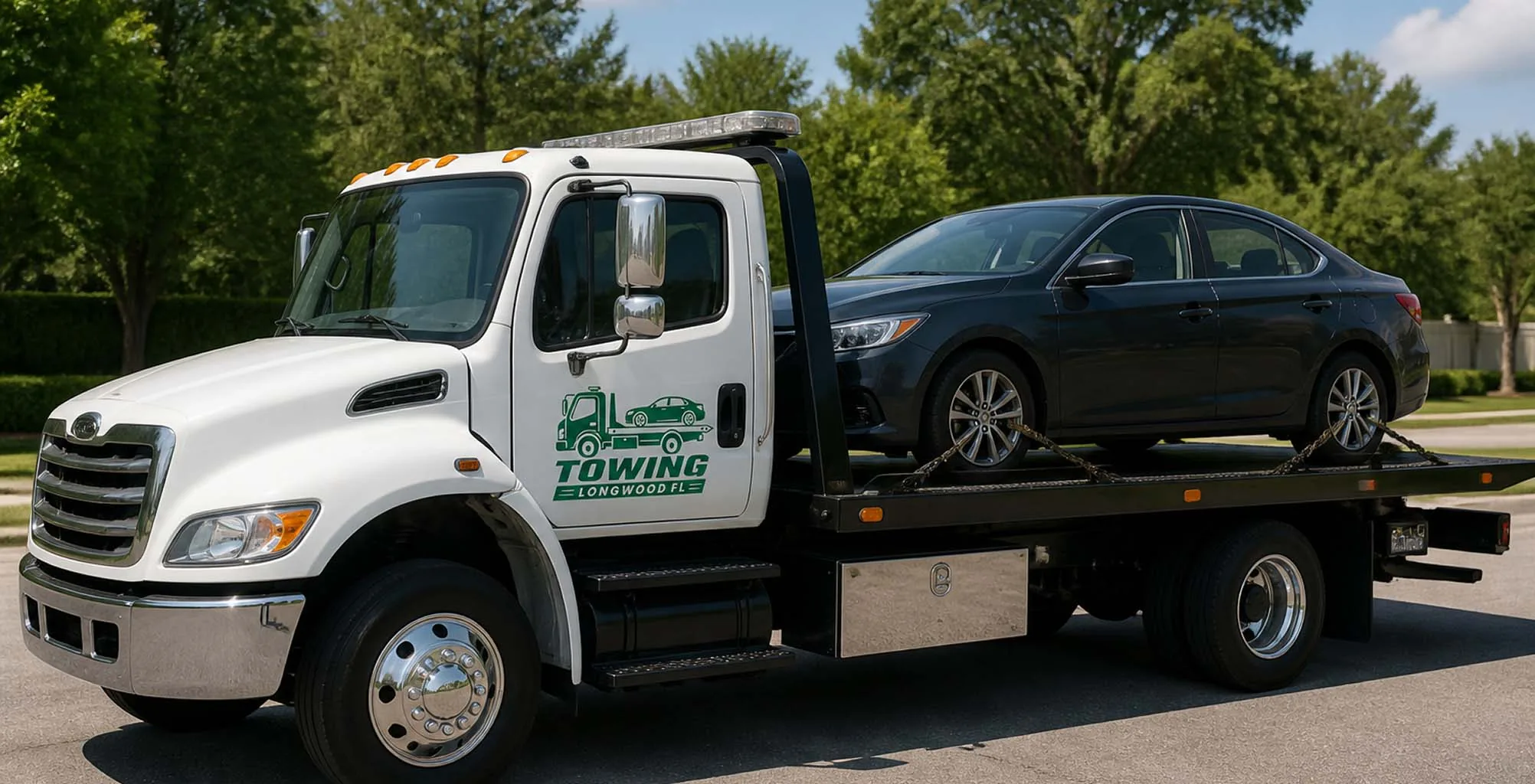
Watch two tow trucks work a breakdown on SR-434 and you will notice they do the job in completely different ways. One slides the whole car onto a flat steel deck; the other lifts just the front wheels and rolls the car away on its back tires. If you have ever wondered which is better for your vehicle, that is the flatbed vs. wheel-lift towing question, and the honest answer is that each method has its place. Choosing well protects your drivetrain, your bumper, and your wallet. This guide breaks down how both methods work, where each one shines, and how to tell a Longwood driver which one your car actually needs.
A Flatbed Carries the Whole Vehicle Off the Ground
Flatbed towing loads your entire vehicle onto a level platform so that no wheel touches the road during transport. The bed tilts and slides back to the pavement, the car is winched or driven up, and then the deck levels off with the vehicle riding on top. Because nothing is dragging or rolling, a flatbed is the gentlest way to move a car that cannot or should not spin its own wheels. Equipment makers such as Miller Industries, the manufacturer behind the Century and Vulcan brands, build these trucks as car carriers, and the same design hauls everything from a stalled commuter sedan to a low-clearance sports car. For anything valuable, damaged, or unusual, the flatbed is the default for good reason.
A Wheel-Lift Tows With Two Wheels Still Rolling
A wheel-lift tows your vehicle by cradling one axle's wheels off the ground while the opposite pair stays on the pavement. A metal yoke slides under the drive or steer wheels, lifts them, and the car trails behind the truck on its remaining two tires. It is the modern successor to the old hook-and-chain method, and because the equipment is lighter and faster to hook up, it is efficient for short moves, tight parking garages, and clearing a stalled car quickly out of a live lane. The trade-off is that two of your wheels keep turning at road speed the whole way, which matters a great deal for some vehicles and not at all for others.
The Difference That Actually Matters Is Your Drivetrain
The deciding factor between the two methods is usually how your car sends power to its wheels. Towing a vehicle with its drive wheels on the ground can force the transmission or differential to turn without the engine running and without proper lubrication, which risks real damage on many all-wheel-drive and automatic vehicles. That is why a flatbed, or a wheel-lift paired with a set of dollies under the trailing wheels, is the safe call for AWD and 4WD cars, and why owner's manuals so often warn against flat towing. A front-wheel-drive car can frequently ride safely on a wheel-lift with its non-driven rear wheels down, while a rear-wheel-drive car needs the opposite arrangement. When there is any doubt, lifting all four wheels clear on a flatbed removes the question entirely.
There is a mechanical reason the drivetrain warning is so consistent. When a car is switched off and rolled on its own drive wheels, the transmission's internal pump may not circulate fluid, so gears and bearings turn dry and heat up over the miles. On many automatics and all-wheel-drive systems, even short distances can shorten a component's life, and manufacturers spell this out in the towing section of the owner's manual for a reason. A flatbed sidesteps the whole issue because the wheels never turn, which is why operators reach for it whenever a vehicle's towing compatibility is unknown.
Ground Clearance, Damage, and the Cars That Demand a Flatbed
Some vehicles should only ever see a flatbed, regardless of drivetrain. Lowered cars, sports cars with front splitters, classics, and vehicles with body damage from a crash can catch, scrape, or twist if any part is dragged or if the suspension is loaded at an angle. A flatbed keeps the car level and fully supported, which is why it is the standard for damage-free transport and for long hauls where hours of trailing on two wheels would add real wear. Professional operators also carry insurance that reflects this responsibility. Florida law requires wrecker operators who are flagged down at a scene to hold at least $300,000 in liability coverage and $50,000 in on-hook cargo insurance, the policy that specifically protects your vehicle while it is riding on the truck. Matching the method to the car is how a good operator keeps that promise.
When a Wheel-Lift Is the Smarter Choice
A wheel-lift is not a lesser option; it is the right tool for a large share of everyday tows. For a compatible front- or rear-wheel-drive car that simply will not start, needing a short move from a Longwood driveway or a US-17-92 shopping center to a nearby shop, a wheel-lift is quick, maneuverable, and usually less expensive because setup is faster. In cramped spots, a parking deck with low ceilings, a car boxed into a tight space, or a vehicle blocking a lane during rush hour near the I-4 interchange, a wheel-lift truck can get in, hook up, and clear out where a full-size carrier would struggle. The key is that the vehicle is compatible with two wheels rolling; when it is, you get the same safe result with less time and cost.
Maneuverability is a real advantage as well. A wheel-lift truck has a shorter working footprint than a full carrier, so it can thread into a crowded apartment lot, a downtown Longwood side street, or a narrow drive-through lane and reposition a car without needing the wide berth a flatbed demands to load. For a quick relocation rather than a long haul, that agility often makes the difference between a fast clear and a complicated one.
Bigger Vehicles Change the Equation
Bigger vehicles change the equation entirely. A stalled van, a shuttle bus, a box truck, or an RV is too heavy for a light-duty wheel-lift, and moving one safely calls for medium- or heavy-duty equipment. The same manufacturers that build light car carriers also build heavy-duty integrated wreckers and rotators for exactly this work, with far greater lifting capacity and stability. For these vehicles the question is less flatbed versus wheel-lift and more about matching truck size to weight, so an operator will ask about your vehicle's class before dispatching. If you drive something larger than a passenger car, the medium-duty towing and heavy-duty towing services in Longwood send the right-sized truck rather than forcing an undersized one to struggle. Getting the weight class right the first time is its own form of damage prevention, protecting both your vehicle and everyone sharing the road with the tow.
Flatbed vs. Wheel-Lift Towing: Common Questions
Is flatbed towing always better than a wheel-lift?
Not always, because a flatbed is safer for more situations but it is not required for every car. A flatbed is the best choice for AWD and 4WD vehicles, lowered or damaged cars, and long distances. For a compatible front- or rear-wheel-drive car on a short local move, a properly used wheel-lift is perfectly safe and usually quicker and cheaper.
Can a wheel-lift damage my all-wheel-drive vehicle?
It can if it is used without dollies, because towing an AWD car with its drive wheels turning on the pavement can harm the transmission or differential. A reputable operator will either use a flatbed or place dollies under the trailing wheels so all four are off the ground. If your car is AWD or 4WD, say so when you call.
Which towing method costs less?
A wheel-lift tow is often slightly cheaper on short local jobs because it hooks up faster and uses a lighter truck. On longer hauls or for specialty vehicles, a flatbed can be the better value once you factor in the risk of drivetrain or body damage from the wrong method. Ask for the total, not just the base rate.
How do I know which method my car needs?
Tell the dispatcher your vehicle's make, model, and drivetrain, plus any modifications such as lowered suspension or existing damage. That information lets the company send the correct truck the first time. When you are unsure, a flatbed is the safe default, and for lowered or luxury vehicles our flatbed towing service in Longwood is built for exactly that kind of careful, damage-free move.
Related Services
Stuck on the Road in Longwood?
Do not wait it out. Call Longwood Towing and a friendly driver will be on the way, any hour of the day or night.
(407) 863-7547Call (407) 863-7547